Salesforce publishes two prices for a small business and leaves four cost lines blank. The $25 and the $100 per user per month are real list prices, checked today. Setup, data migration, training and the hours someone on your team spends running the thing appear on no Salesforce page at all.
Almost every cost guide for this question fills that gap with numbers from firms that sell Salesforce implementations. This article separates the two: published prices get a figure and a date, and the unpublished lines get an honest label plus a method for pricing them yourself.
Key Takeaways
- The published licence floor for a five-person team is $1,500 a year. That is Starter Suite at $25 per user per month, which can be paid monthly or annually (checked 2026-11-13). Pro Suite quadruples it to $6,000 and has to be paid annually under contract.
- Free Suite is permanent, not a trial, but it caps at two user licences. It also deactivates if nobody signs in for 60 days, and its marketing sending limit is 100 emails a month.
- The $10,000 to $50,000 implementation ranges you will read are published by implementation sellers. One of those guides also states that implementation runs 1.5 to 3 times annual licence cost, which for a five-person Starter rollout works out at $2,250 to $4,500, not $10,000.
- Most of the add-on catalogue starts above the small-business suites. Four Sales add-ons are sold on Pro Suite; the rest need the $195 Core edition first, so the real upgrade step is $100 to $195 per user, not $100 plus an add-on.
- HubSpot publishes a $1,500 onboarding fee and Pipedrive gives setup away above $400 a year. Salesforce publishes neither, which is why setup is the one line in a Salesforce budget you cannot fill in from a public page.
- The line nobody prices is your own time. Name the person who will own the CRM, cost their hours at your loaded rate, and put that number in the budget before you compare vendors.
A small business asking what Salesforce costs is asking two questions at once: what goes on the card every month, and what the whole thing will have cost by the time it works. The first has a public answer. The second depends almost entirely on whether you need custom objects and automation, which is also the line Salesforce draws between its two small-business suites. So start with the published numbers, then price your own project against them.
What Salesforce Costs a Small Business in 2026
Salesforce Pricing
| Plan | Price |
|---|---|
| Free Suite (2 user licences) | $0 |
| Starter Suite | $25/user/month (billed monthly or annually) |
| Pro Suite | $100/user/month (billed annually, contract required) |
| Core | $195/user/month (billed annually) |
| Advanced | $395/user/month (billed annually) |
| Max | $550/user/month (billed annually) |
Free Suite, Starter Suite and Pro Suite checked 2026-11-13 on Salesforce's own small-business pricing page; Core, Advanced and Max checked 2026-10-28 on the Sales Cloud pricing page. All figures are US list prices per user per month. The euro list carries the same numerals, so Starter reads 25 € and Pro Suite 100 € for a euro-zone buyer.
Two things on that table matter more than the numbers.
Both small-business suites are labelled as starting prices with transaction fees applying (checked 2026-11-13), which makes $25 a floor rather than a ticket price. The Commerce features are where those fees land.
And the free tier is genuinely free rather than a 30-day trial. Free Suite comes with two user licences, no contract and no card, and never expires provided someone logs in at least once every 60 days (checked 2026-11-13). It carries lead, opportunity and case management, custom landing pages, AI that drafts and summarises, and a marketing sending cap of 100 emails a month. For a two-person consultancy that wants its pipeline out of a spreadsheet, the published cost of Salesforce is zero. For a tier-by-tier read of what the $25 seat includes and where it stops, our breakdown of Salesforce Starter Suite pricing goes deeper than this budget view.
What Salesforce Publishes, and What It Leaves to a Sales Call
This is the table the cost guides should lead with and none of them does. Before you can budget, you need to know which lines have a public number attached.
| Cost line | Where the figure comes from |
|---|---|
| Free, Starter, Pro, Core, Advanced, Max seats | Published list price |
| Sales add-ons such as Dialer, Engagement, Maps | Published list price on the add-ons page |
| Marketing Cloud Account Engagement | Published, from $1,250/month for up to 10,000 contacts |
| Marketing email capacity above the included allowance | Published as an add-on |
| Web Services API on Starter and Pro Suite | Labelled add-on available, no price on the suite page |
| Premier Success Plan on Starter and Pro Suite | Add-on, quote only |
| Implementation, data migration, training | Not published by Salesforce at all |
| Administration time after go-live | Not published by anyone |
Checked 2026-11-13 across Salesforce's small-business pricing, free CRM and Success Plans pages, and the Sales Cloud add-ons page.
Salesforce is not hiding this. Its own small-business pricing FAQ asks whether there are upfront costs or additional fees, and answers by inviting you to contact the company to discuss what you want to add (checked 2026-11-13). That is a straight answer to a budgeting question: the part that varies is quoted, not listed.
The practical consequence is that a Salesforce budget has a hard half and a soft half, and the soft half is the one that decides whether the project feels cheap or expensive. If you want to work through the soft half before you sign anything, you can build the booking, qualification and follow-up part of the same workflow on a free plan in an afternoon and see what is left for the CRM to do: start free with meetergo and keep the CRM decision for later.
Annual Prepayment Is a Cash-Flow Line, Not Just a Total
Starter Suite is the only small-business tier that can be paid monthly. Pro Suite is billed annually and requires a contract, and Salesforce's own FAQ states that most of its products use annual contracts (checked 2026-11-13).
For a five-person team that is the difference between $125 a month and a $6,000 commitment for the year. A business with 60-day receivables feels that more sharply than it feels the per-seat price, and it is the single most common surprise in the move from Starter to Pro.
One claim repeated across the cost guides is worth correcting here. Several say Starter Suite is limited to roughly ten users. Salesforce's pricing FAQ states plainly that Starter has no user maximum (checked 2026-11-13). What pushes teams off Starter is features, not headcount: forecasting, quoting, custom objects, Flows, the sandbox and AppExchange access all sit on Pro Suite and above (checked 2026-11-13). If your constraint is people rather than process, you can stay on the $25 seat longer than most guides suggest.
Every tier also starts with a 30-day free trial, which is the cheapest way to test whether your process fits before any money moves.
Where the $10,000 Implementation Figures Come From
Search this question and the first page belongs to Salesforce implementation partners. Their numbers are the ones that get quoted everywhere, so they deserve to be read properly rather than repeated.
Cynoteck's 2026 implementation guide puts small-business implementation at 1 to 10 users for $10,000 to $50,000 over four to eight weeks, and models a five-user Starter Suite rollout at $10,000 to $20,000 of implementation plus $3,000 of training on top of $1,500 of annual licences, for a year-one total of roughly $17,000 to $27,000 (Cynoteck Salesforce implementation cost guide, checked 2026-11-13).
Read a little further down the same page and it states a rule of thumb: implementation typically runs 1.5 to 3 times your annual licence cost. Apply that to its own five-user Starter scenario and you get $2,250 to $4,500. The page carries both figures, and they differ by a factor of four.
That is not a gotcha, it is a signal about what the larger range describes. Ten to fifty thousand dollars buys a configured platform with custom objects, integrations and change management, which is a Core-edition project. It does not describe importing a contact list into Starter Suite, where Salesforce's own small-business pages promise guided onboarding and describe the product as usable within minutes with no IT team involved (checked 2026-11-13).
Worth naming the incentive: the guides quoting the widest ranges sell implementation services, and the call to action beside that table is a free cost assessment. The ranges are not invented, but they are priced from the projects those firms get hired for.
So treat implementation as a conditional line. If your answer to "do we need custom objects, multi-step automation or a system integration on day one" is no, budget your own hours. If it is yes, you are no longer pricing a small-business suite, and a partner quote is the right instrument.
Setup, Migration, Training and Admin, Line by Line
Setup
On Starter Suite this is honestly close to nothing: guided onboarding, a default pipeline, email and calendar connected to Gmail or Outlook. The effort arrives at the first customisation, because Pro Suite is where custom objects, Flows and the sandbox appear, and those are decisions about what a record means and who owns it rather than switches to flip.
Data migration
Nobody publishes a price for this because the work is in your data, not in Salesforce. Exporting contacts is an hour. Deciding which spreadsheet is authoritative, merging duplicates and agreeing what counts as a qualified lead is the part that takes a week. Budget it in days of your own time, and clean before the import rather than after.
Training
Trailhead, Salesforce's learning platform, is free, and the Standard Success Plan with its knowledge base and community access comes with every licence (checked 2026-11-13). The $3,000 training line in the partner models buys instructor-led sessions, so it is substitutable. The hours your team spends not selling while they learn are not, and they belong in the budget either way.
Administration after go-live
Here is the omission that matters most for a small business. The partner models carry a $40,000 to $60,000 part-time administrator for a 50-user mid-market rollout and no admin line at all for the five-user scenario. That is backwards from how it feels in a small company, where there is no admin role and the owner or the most technical salesperson absorbs the work.
Price it directly. Pick the person, estimate two to four hours a week for the first quarter and one to two after that, multiply by your loaded hourly cost. A single owner at four hours a week is a real five-figure line over three years, and it is the number that decides whether the CRM is still being updated next summer.
Integrations and usage overages
Web Services API access is labelled an add-on on both Starter and Pro Suite rather than an included feature (checked 2026-11-13), so if your other tools talk to Salesforce through the API, get that price before you commit. Marketing sending is also metered: an October check of the pricing page put the included allowance at 2,000 emails a month with each further 1,000 at $10 (checked 2026-10-06).
AI is the least predictable line. Agentforce for Sales is $125 per user per month, Flex Credits run $500 per 100,000, conversation pricing is $2 per conversation, and unused credits do not roll into the next term (checked 2026-10-28). Credits that expire are a budget decision, not a subscription, so cap them deliberately.
Three Small-Business Budgets, Built Only from Published Prices
These are not forecasts. They are what Salesforce's own pages commit to in writing for three common shapes of small business, with the unpublished lines named rather than estimated.
Two-person consultancy, Free Suite
| Cost line | Published amount |
|---|---|
| 2 user licences | $0 |
| Marketing sending above 100 emails/month | Requires a paid suite |
| Paid support | Quote only |
Published cost for year one: $0. Unpublished: your setup hours, and the discipline of logging in every 60 days so the org stays active.
Five-person team, Starter Suite
| Cost line | Published amount |
|---|---|
| 5 licences, $25/user/month | $1,500/year |
| Email capacity beyond the included allowance | $10 per extra 1,000 sends |
| Web Services API | Add-on, price not on the suite page |
| Premier Success Plan | Add-on, quote only |
Published licence cost: $1,500 in year one and $4,500 across three years. Unpublished: data cleaning, your configuration hours, and the admin time above.
Five-person team, Pro Suite
| Cost line | Published amount |
|---|---|
| 5 licences, $100/user/month | $6,000/year, prepaid |
| Sales Dialer, from $5/user/month | $300/year |
| Configuration of custom objects and Flows | Not published |
Published licence cost: $6,000 in year one and $18,000 across three years, with the first year payable up front under contract.
The honest answer to the keyword sits in those three blocks. Salesforce's published cost for a small business of five people is $0, $1,500 or $6,000 a year, and everything above that figure is your own project. The guides quoting $17,000 to $27,000 for year one are not describing the $1,500 subscription; they are describing the consulting engagement bolted to it.
The Add-On Catalogue Mostly Starts Above the Small-Business Suites
If your plan is to run a cheap suite and buy the one add-on you need, check the edition tags first. On the Sales Cloud add-ons page, the items sold on Pro Suite are Sales Dialer from $5 per user per month, Sales Engagement at $50, Salesforce Maps from $75 and Social Intelligence at $25 (checked 2026-11-13).
Almost everything else is tagged for Enterprise, Core and above: Agentforce for Sales at $125, Sales Programs at $100, Salesforce Contracts at $50, Sales Planning at $75, Revenue Cloud Advanced at $200 and Revenue Intelligence at $250, all per user per month (checked 2026-11-13). Marketing Cloud Account Engagement starts at $1,250 a month for up to 10,000 contacts on annual billing, which is more than twice a five-person Pro Suite bill by itself.
So the upgrade path for a small business that needs one more capability is often not $100 plus an add-on. It is $195 per user first, and then the add-on. For five people, that step alone adds $5,700 a year.
One caveat on reading those tags. The add-ons page lists editions under both their legacy and current names, Enterprise next to Core and Unlimited next to Advanced, and never uses the word "requires". Treat the tags as a strong indication rather than a contractual minimum, and confirm availability for your edition before you plan around it.
How the Setup Bill Compares With Other Small-Business CRMs
The ranking cost guides compare CRM entry prices. The more useful comparison for a budget is the one none of them makes: which vendors put a number on setup.
HubSpot publishes its onboarding as a line item. Sales Hub Free is $0 for up to two users, Starter starts at $7 per seat per month on an annual commitment or $20 billed monthly with discounts limited to new customers, and Professional at $90 per seat per month carries a required one-time onboarding fee of $1,500. Enterprise is $150 per seat per month with a $3,500 one-time onboarding fee (checked 2026-11-13). You may not like the number, but you can put it in a spreadsheet before you sign.
Pipedrive goes the other way and prices setup at zero above a threshold: Lite is €14 per seat per month billed annually, Growth €39, Premium €59 and Ultimate €79, and the pricing page states that implementation is free on any plan over $400 a year (checked 2026-11-13). Zoho CRM keeps a permanently free edition for up to three users and advertises free onboarding, though its pricing page rendered only rupee figures on the day of checking.
Salesforce publishes neither a setup fee nor a free-setup promise for its small-business suites. That is not evidence it costs more. It does mean the setup line is the one cost in your budget you cannot fill in from a public page, and that is the structural reason this search returns consultancy guides instead of a price list.
Two discount routes are published and worth knowing. Nonprofits that qualify for the Power of Us programme get ten Nonprofit Cloud licences at no cost, and nonprofit list pricing runs $70 per user per month for Sales and Service Core against $195 commercially, with Premier Success included (checked 2026-11-13). There is no equivalent published startup programme on those pages, so a startup discount is a negotiation rather than a rate.
What Buyers Say the Price Feels Like
Customer Reviews
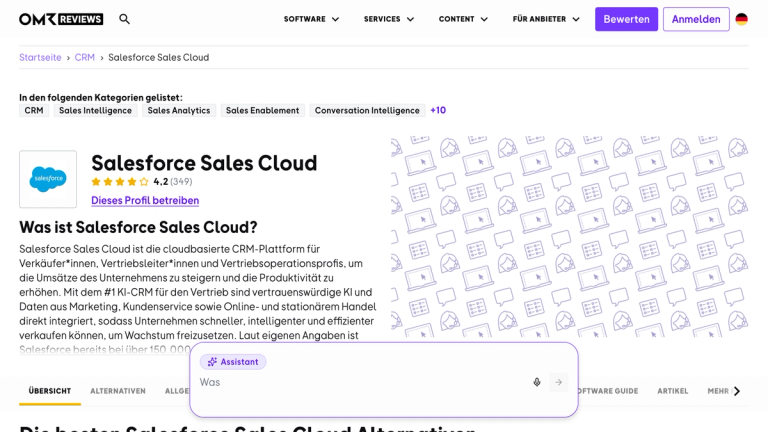
Salesforce Starter holds 4.4 out of 5 from 226 reviews on Capterra, with value for money scored separately at 4.0 out of 5 from 148 ratings. Seventy-seven percent of reviewers rate value as good or excellent, while likelihood to recommend sits at 65% (Salesforce Starter reviews on Capterra, checked 2026-11-13).
The recurring positive is that the entry price buys sales, service and basic marketing in one place without a procurement process. The recurring complaint is upgrade pressure: reviewers describe hitting the limits of automation and customisation and finding that the fix is the next tier rather than a setting.
Independent 2026 test reviews score the value lower than the crowd does, with pricing and value rated 2.0 out of 5 in one, on the grounds that Starter omits workflow automation and custom objects (StartupOwl Salesforce review, checked 2026-11-13).
Both numbers describe the product. Neither describes the rollout, because nobody writes a review of their own data migration.
Cutting the Bill Without Cutting the CRM
- Buy seats only for people who work deals. You can add products or upgrade at any time per Salesforce's own FAQ (checked 2026-11-13), so there is no discount logic that rewards over-buying on day one.
- Stay on Starter until a named feature forces the move. Write down which one it is: forecasting, quoting, custom objects, Flows, the sandbox or AppExchange. If you cannot name it, the $75 per user per month gap to Pro Suite is not yet buying you anything.
- Exhaust Trailhead and the included Standard Success Plan before buying training. Paid training is a line you can move, unlike licences.
- Cap AI spending as a separate decision. Flex Credits expire at the end of the term, so an unused allowance is a sunk cost rather than a credit you carry forward.
- Keep the pre-CRM work out of the CRM. Booking, intake forms, reminders and the paperwork that follows a won deal are where most small-business configuration effort goes, and they are the cheapest part of the stack to run elsewhere. Done properly, Salesforce receives qualified records instead of raw inbound, and you buy fewer seats and less automation. Our guide to calendar and CRM scheduling with Pipedrive walks through that pattern on a smaller CRM, and it transfers.
Where meetergo Fits if the Budget Does Not Stretch
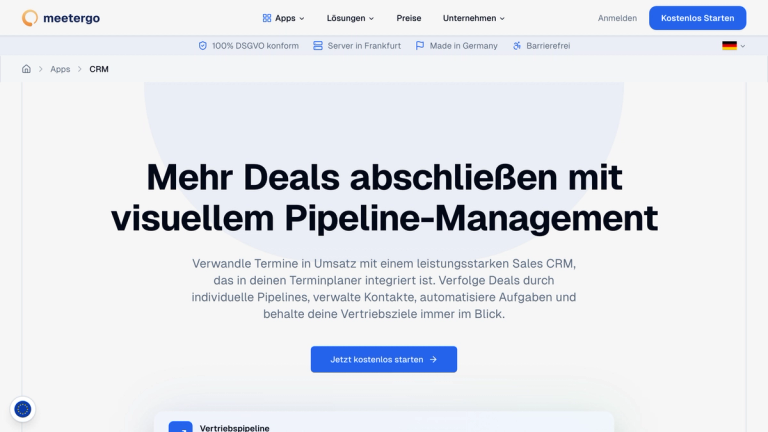
meetergo is a German suite of customer-facing apps: booking pages, a shared inbox across website chat, email and messaging channels, forms, e-signatures, invoices, and a sales CRM with a visual pipeline. It is hosted and processed in Germany, with servers in Nuremberg, which is a corporate-jurisdiction fact rather than a market one: the company has no US parent that could be compelled to hand over customer data. For a small business budgeting a CRM, the relevant difference is that the appointment and the deal record live in the same product, so the configuration project that drives Salesforce's unpublished costs mostly does not exist.
Bookings that create the CRM record
Anyone who books a meeting or fills in a form becomes a contact, with the meeting, the form answers and the message history attached. There is no mapping step and no sync to debug, which removes the most common reason a small team's CRM goes stale within a quarter.
A pipeline with a forecast, out of the box
Deals move through stages by drag and drop, with a win probability per stage, a loss reason on closed deals and a flag when one sits too long. The reporting side gives weighted forecast, sales cycle and win rate from the pipeline itself, which on Salesforce is a Pro Suite feature.
Contracts and invoices on the same contact
E-signatures and invoices run against the contact record, so the quote, the signature and the payment stay with the deal. That matters for the cost comparison, because those are usually two more subscriptions in a small-business stack.
Keeping Salesforce and bridging to it
If Salesforce is already in place, or the enterprise features genuinely apply, the two can coexist: bookings and appointment data flow into Salesforce through meetergo's Salesforce integration, which sits on the Premium plan. That is the cheaper half of the pattern described above, where the CRM receives qualified records instead of doing the qualifying.
meetergo Pricing
| Plan | Price |
|---|---|
| Free (up to 3 people) | €0, free forever |
| Light | €9.90/person/month, €118.80/year |
| Suite | €34.90/person/month, €418.80/year |
| Premium | €59.90/person/month, €718.80/year |
| Enterprise (from 30 seats) | On request |
Regular prices on yearly billing, excluding VAT, checked 2026-11-13 on the meetergo pricing page. A person is a team member with their own login; clients who book never count. Every plan carries the CRM, Free included, and the paid plans come with a seven-day trial that needs no card.
For the five-person team in the budgets above, Suite comes to €2,094 a year with bookings, the shared inbox, unlimited e-signatures and invoices, and the CRM included. That is between the Starter and Pro Suite licence totals, and it replaces more of the stack.
Where meetergo Falls Short
meetergo is not an enterprise CRM and should not be sold as one. There are no custom objects, no territory management, no CPQ, no industry clouds and nothing resembling Marketing Cloud. If you need forecasting across dozens of reps, a configurable data model or a platform your developers will build on, Salesforce is the right tool and the implementation cost is the price of that capability. If your CRM needs stop at contacts, deals, tasks and a forecast, you are paying Salesforce for a configuration layer you will not use.
Customer Reviews
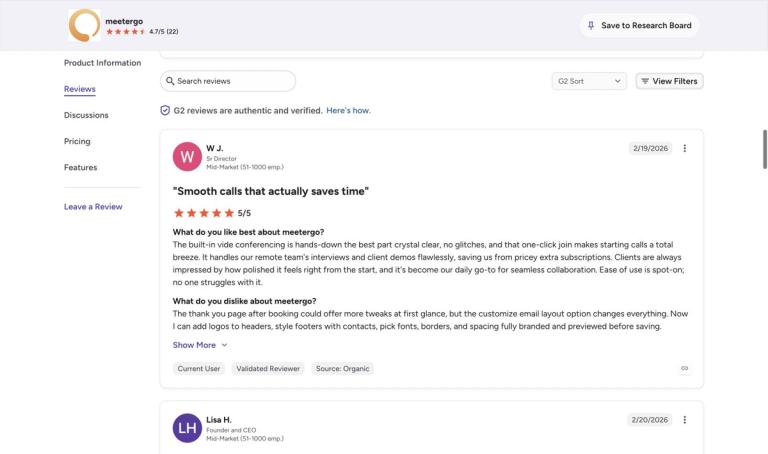
meetergo displays a 4.8 rating and more than 50,000 customers on its own pages, but no public review count next to it, so take the figure as a badge rather than as sourced evidence. The attributed customer voices are more useful: on meetergo's sales solutions page, Markus of MERWERT GmbH credits the depth of appointment types and workflows alongside GDPR compliance and German hosting as the reason the tool held up in B2B, and Frank of EverSell System reports having gone looking for weaknesses after testing many tools and not finding the usual annoyances. The recurring theme across both is configuration depth without a project.
Is Salesforce Worth the Cost for a Small Business?
Three clear answers, depending on which small business you are.
If you have one or two people and a pipeline in a spreadsheet, Free Suite is the best-value CRM on this page at $0, and the only cost is your own setup time. If you have three to ten people selling a reasonably standard product and you need a shared pipeline, email nurture and reports, Starter Suite at $1,500 a year for five is genuinely cheap, and most of the scary totals in other guides do not apply to you.
If you need custom objects, multi-step automation or systems integration, you are looking at Pro Suite or Core, an annual prepayment, and a real project. Whether the platform suits your business at all is a separate question from what it costs, and our review of Salesforce for a small business works through the fit rather than the budget. Price the partner quote and your own admin hours together, because the second one outlasts the first. And if what you actually need is for appointments and enquiries to stop living in one tool while the paperwork lives in another, a CRM is the wrong first purchase; the cheapest CRM plans compared on annual cost and our guide to choosing a CRM for a small business are better starting points than an edition table.
Whichever way the Salesforce decision lands, the pre-CRM half of the workflow is the part you can price exactly. meetergo's CRM and booking apps run on the free plan for up to three people, so opening an account costs a morning rather than a budget line.
Put bookings, deals and invoices on one contact record.

Put bookings, deals and invoices on one contact record.
Salesforce Small Business Cost FAQs
How much does Salesforce cost per year for five people?
On published list prices, $1,500 a year on Starter Suite or $6,000 a year on Pro Suite, both at five users (checked 2026-11-13). Free Suite covers two users at no cost. Those figures are licences only; setup, migration, training and administration are not published by Salesforce.
Can you pay for Salesforce monthly?
Only on Starter Suite, which is billed monthly or annually. Pro Suite is billed annually and requires a contract, and Salesforce states that most of its products use annual contracts (checked 2026-11-13).
Is Starter Suite limited to ten users?
No. Salesforce's pricing FAQ states there is no user maximum on Starter Suite (checked 2026-11-13). What moves teams up a tier is features such as forecasting, quoting, custom objects and Flows, not headcount.
Does Salesforce charge separately for implementation?
Salesforce does not publish an implementation price. Its small-business FAQ answers the question about upfront costs by inviting a conversation with sales (checked 2026-11-13). Implementation is sold by partners, and the public anchor points are the ranges those partners publish, from roughly $10,000 to $50,000 for a business of one to ten users (checked 2026-11-13). For contrast, HubSpot publishes a required one-time onboarding fee of $1,500 on its Professional tier and Pipedrive states implementation is free above $400 a year (both checked 2026-11-13).
What are the hidden costs of Salesforce for a small business?
Five recur: annual prepayment on Pro Suite and above, the Web Services API as a paid add-on on both small-business suites, metered marketing email sending, AI credits that expire at the end of the term, and paid support, which is an add-on quoted on request on Starter and Pro while being included on Core and above (checked 2026-11-13).
How much should we budget for the first year?
Take the published licence figure, add your own hours at a loaded rate for setup, data cleaning and the first quarter of administration, then add a partner quote only if you need custom objects, automation or an integration on day one. For a five-person Starter Suite rollout with no customisation, year one is the $1,500 of licences plus one to two weeks of internal time.
Is there a cheaper way to get appointments into a CRM?
Yes, and it is usually the better order of operations. Booking, intake, reminders and the signature-and-invoice step can run on a tool that creates the CRM record itself, which keeps the expensive platform for the work that needs it. meetergo carries the CRM on its free plan as well as its paid ones, and connects to Salesforce from the Premium plan for teams that keep both.