Key Takeaways
- SuiteCRM is a free, open-source CRM you host yourself, and the licence is the only free part. The AGPLv3 download costs nothing. Hosting, patching and the support contract are where the money and the hours go.
- A managed, supported instance starts at about £1,560 a year, before a one-off setup fee from £2,520 (checked 15 November 2026).
- Your automation speed is a line item. On the entry hosting package, workflows run once an hour. Every four minutes means the next package up.
- Customisation is the real reason to pick it. Custom modules and fields built in the admin interface, with no per-user licence fee, is a combination almost no hosted CRM offers.
- It manages customers, it does not win them. No booking page, no e-signature, no invoicing, so a small service team buys those separately.
SuiteCRM began as the last open release of SugarCRM's Community Edition and has run as its own project since October 2013. Thirteen years on it is still PHP and MySQL, and still the answer a lot of people give when someone asks for a CRM without per-seat pricing.
The question here is narrower than whether it is good: should a small service team, five to twenty people who sell their time, run it? The vendor prices the work around the free licence openly enough to total up first.
SuiteCRM at a Glance
| Item | Detail |
|---|---|
| What it is | Open-source CRM for sales, marketing and support |
| Licence | AGPLv3, free to download |
| Current releases | 8.10.2 and 7.15.2 ESR, both dated 31 July 2026 |
| Stack | PHP, MySQL or MariaDB, cron for scheduled tasks |
| Maintained by | SuiteCRM Ltd, a UK company |
| Deployment | Self-hosted, or managed hosting with a 30-day trial |
| Best for | Technical teams needing heavy customisation |
| Weakest for | Service teams needing booking and billing in one tool |
What SuiteCRM Actually Costs in Year One
Most reviews stop at free. The vendor's pricing page splits the decision three ways, into hosting, implementation and a support level, and prices each one.
| Item | Price |
|---|---|
| Self-hosted software, AGPLv3 | Free to download, plus your own infrastructure |
| Managed hosting, entry level | From £50 a month, with application support required on top |
| Hosted Starter, up to 10 users, 5 GB | £130 a month billed annually, £143 billed monthly, excluding VAT |
| Hosted Business, up to 50 users, 40 GB | £180 a month billed annually, £198 billed monthly |
| Hosted Premium, up to 150 users, 120 GB | £280 a month billed annually, £308 billed monthly |
| Dedicated instance | From £3,200 a year, excluding VAT and application support |
| Quick Start implementation and one training day | From £2,520, one-off |
| Standard Support, 10 prepaid hours | £1,200, or £960 bought alongside managed hosting |
| SuiteASSURED, 10 care hours with warranty and indemnities | From £3,350 a year |
| Community support | Free |
All figures checked on the vendor's pricing and hosting pages, 15 November 2026.
Two of those rows look contradictory, and reconciling them gives you the number to budget. The pricing page advertises managed hosting from £50 a month, then works an example at £600 of hosting plus £960 of support: £1,560 a year. The hosting page's cheapest package, Starter, is £130 a month billed annually, which is also £1,560 a year, and it bundles a support package at a reduced rate. Either route, the floor for a managed and supported SuiteCRM is around £1,560 a year, not the roughly $95 a month several older reviews still quote.
With the Quick Start setup added, year one looks like this, in the vendor's own two example configurations:
| Configuration | Year one | Each year after |
|---|---|---|
| Managed hosting plus Standard Support plus Quick Start | £4,080 | £1,560 |
| Managed hosting plus SuiteASSURED plus Quick Start | £6,470 | £3,950 |
Self-hosting replaces all of that with a server bill and your own hours: cheaper in cash, not automatically cheaper overall.
If you would rather not own a server, you can set up a hosted CRM with contacts, pipelines and forecasting on meetergo's free plan in an afternoon and start without a credit card to see whether the data model fits how you sell.
What You Take On When You Host It Yourself
The free download is a PHP application, not a service. Choose it and your team owns this list for as long as the CRM runs.
- A LAMP-style stack, on a PHP version that stays inside the supported range.
- A cron job. SuiteCRM's scheduled tasks, workflow rules and inbound email checks only run when cron runs them.
- Security patching on your own schedule. The project ships out-of-band PHP security releases and nobody applies them for you.
- Database backups, and a restore you have tested.
- Version strategy. Both lines were released on 31 July 2026, and moving from 7.15.2 to 8.10.2 is a separate migration package, not an in-place update.
- Every customisation re-tested after each upgrade.
None of that is unusual for self-hosted software. It is labour a per-seat CRM bill would have absorbed, and a five-person consultancy with no systems administrator should price it at a real hourly rate before calling it free.
The managed route has a cost the reviews miss. Scheduled tasks and workflows run hourly on Starter, every four minutes on Business, every two minutes on Premium and every minute on a dedicated instance. If you need a reminder or a lead-routing rule to fire while the prospect is still on the phone, the entry package at £130 a month does not do it and the £180 a month package is the real starting point.
SuiteCRM Key Features
Every module below is in the free download, not behind a tier.
Contacts, accounts, leads and opportunities. The standard four-object sales model with one-step lead conversion. Custom fields and whole custom modules are built in the admin interface, not in code.
Quotes, products and invoices. A product catalogue, line-item quotes and a conversion from an accepted quote into an invoice. It generates documents rather than collecting money, so reconciliation happens in your accounting tool.
Workflow automation. Condition-and-action rules that update fields, create records or send email when a record changes or a date passes. Powerful, and entirely dependent on how often cron runs.
Email and campaigns. Inbound mailbox monitoring, templates and bulk campaigns with target lists. This is also the module reviewers complain about most, usually about deliverability and inbound mailbox reliability.
Reporting, cases, projects and calendar. A report builder over any module, including custom ones, with charts and scheduled delivery, plus a support-case queue, Gantt-style project planning and a shared activity calendar. That breadth is why SuiteCRM appears in public-sector catalogues, including the European Commission's Interoperable Europe solution listing.
Integrations are thinner than the module list suggests. The vendor publishes an Outlook plugin and a REST API; everything else comes through the add-ons store or a developer, including telephony, e-signature and anything client-facing such as a booking page (checked 15 November 2026).
Who SuiteCRM Is For, and Who Should Skip It
Where SuiteCRM shines
- Customisation depth without a licence negotiation.
- Full data ownership, including the choice of country and provider.
- No per-user fee, so read-only staff cost nothing but server performance, the opposite of how hosted CRMs price growth.
- An exit path: the data is in your own MySQL database, and the module set is broad enough to replace several small tools.
Where SuiteCRM falls short
- The version 7 interface looks its age, and version 8 is still catching up on feature parity.
- Setup and upkeep need someone technical permanently, which is a hiring question rather than a project.
- Free support means community forums, with paid hours as the only guaranteed route.
- The email module draws the most consistent criticism from reviewers.
- Nothing in it helps a prospect book you, sign with you or pay you.
Skip it if nobody on the team wants to own a server, or if your bottleneck is winning work rather than recording it. A consultancy losing deals to slow scheduling and manual proposals gets more from a CRM sitting next to the calendar than from a customisable database, and if the appeal was mainly the zero price, the hosted free CRM plans worth comparing cost nothing either and need no maintenance.
Teams that chose open source for data control should weigh where your customer data actually sits, because an EU-hosted managed product can satisfy that requirement without the sysadmin work.
Closer alternatives if SuiteCRM is nearly right: Odoo has the same open-source core plus accounting and inventory, at the price of an ERP-sized implementation. EspoCRM is the lighter self-hosted option, modern interface and smaller module set. Zoho CRM fits a buyer who wants a per-seat tier ladder, HubSpot one who wants marketing in the same account, and both trade customisation depth for someone else running the servers.
SuiteCRM Customer Reviews
Review volume is modest, as it tends to be for self-hosted software. Software Advice shows 4.2 out of 5 from 48 reviews, with value for money the strongest sub-score at 4.75 and support the weakest at 3.5 (checked 15 November 2026). G2 shows 4.2 out of 5 from 99 reviews, around two thirds of them from small businesses. Both sets praise the customisation and the absence of licence fees; the complaints cluster on the dated interface, the technical setup and support response when something breaks. The full sets are on the Software Advice SuiteCRM reviews page and on G2's SuiteCRM reviews.
meetergo: When the Front Office Is the Bottleneck
meetergo is a German platform whose CRM sits in the same product that handles booking, messaging, signatures and invoices. It is hosted, which is the opposite trade from SuiteCRM: you give up owning the server and get the parts of a client workflow SuiteCRM leaves to other tools.
For a service team the record starts before the first conversation: someone books a slot or sends a form, and the contact exists without anyone typing it.
Contacts that create themselves
Anyone who books an appointment or submits a form becomes a contact, with the meeting, the form answers and the notes on one record. Chats from WhatsApp, Instagram, Telegram and the website widget land on that same contact instead of in a separate inbox.
A pipeline with forecasting built in
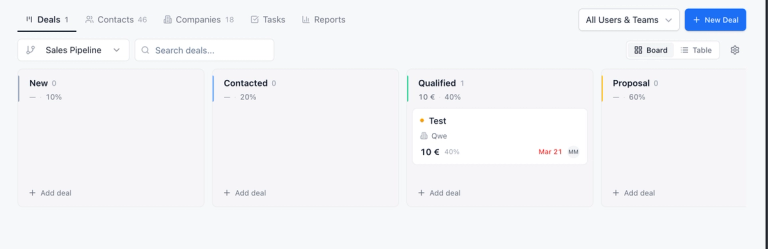
Deals move through drag-and-drop stages across as many pipelines as you need, each with its own required fields. Stalled deals get flagged, win probability is set per stage and adjustable per deal, and lost deals carry a reason. Reports cover weighted forecast, win rate, average sales cycle and demo-to-proposal conversion.
The workflow after the deal
E-signatures and invoices run on the same contact record, three of each a month on Free and Light and unlimited from Suite, so the proposal, the signature and the bill stay on one timeline. Automation is capped at three workflows on Light and unlimited from Suite.
Interfaces for the technical half
A REST API and an MCP server are on every plan including Free, webhooks and Zapier from Light. HubSpot and Pipedrive sync from Light, Salesforce from Premium, and CSV import maps columns with one-click duplicate merging.
Data sits on servers in Nuremberg, Germany, under a German company, and the product is GDPR-compliant.
The honest limitation: meetergo is not self-hostable and the source is not public. If your requirement is that the application and database run on hardware you control, SuiteCRM meets it and meetergo does not. The free plan also caps deals at ten, a trial allowance rather than a working CRM.
meetergo pricing
| Plan | Price |
|---|---|
| Free | €0, up to 3 people, free forever |
| Light | €12.90 per person a month |
| Suite, 3 people included | €99 a month |
| Premium, 3 people included | €179 a month |
| Team seat for time and projects only | €4.90 per person a month |
| Enterprise, from 30 seats | Price on request |
Regular list prices from meetergo's pricing page, checked 15 November 2026, excluding VAT. The paid plans have a 7-day trial with no credit card, and the free plan has no time limit.
meetergo customer reviews
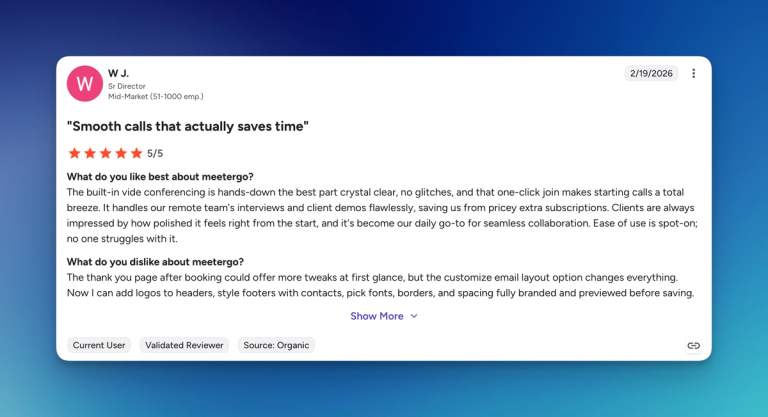
meetergo publishes 41 individual customer reviews with their sources, 27 from OMR Reviews, 9 from Trustpilot, 3 from Google and 2 from G2, at an average of 4.8 out of 5 (checked 15 November 2026). The recurring themes are how quickly a booking page goes live and how fast support answers. The full set, in the reviewers' original wording, is on the meetergo customer reviews page.
Put contacts, deals and invoices on one timeline.

Put contacts, deals and invoices on one timeline.
Verdict: Is SuiteCRM Worth It in 2026?
SuiteCRM is worth it when customisation and data ownership are the requirement and you have, or will hire, the capacity to keep a PHP application healthy for years. On those terms it remains one of the best deals in business software: a full CRM, no per-seat fee, and a data model you can reshape without asking permission.
It is not worth it as a way to avoid paying for a CRM. Managed and supported it runs about £1,560 a year plus a setup fee from £2,520, and self-hosted the bill moves from an invoice to your own calendar. The sharpest question is not open source against hosted. It is whether your problem is recording customer relationships or creating them. SuiteCRM is good at the first and silent on the second.
SuiteCRM FAQs
Is SuiteCRM really free?
The software is, under the AGPLv3, with no per-user licence fee and no feature tiers, and the forums and documentation cost nothing. Everything else is priced: managed hosting from £50 a month, implementation from £2,520, ten support hours from £1,200 (checked 15 November 2026).
What kind of server does SuiteCRM need?
A standard PHP and MySQL or MariaDB environment on a supported PHP version, with a working cron job for scheduled tasks and workflows. Budget shared hosting usually fails on the cron and the PHP limits rather than on disk or memory.
Should I start on SuiteCRM 7 or SuiteCRM 8?
Both lines are current, 8.10.2 and 7.15.2 ESR, released on 31 July 2026. New installations generally start on 8 for the newer interface, while the 7.15 extended-support release suits instances with heavy legacy customisation. A separate migration package moves 7.15.x to 8.x.
Can SuiteCRM handle a large database and a lot of users?
Yes, to hundreds of users. On managed hosting the ceiling is the package: Starter for up to 10 users on 5 GB, Business for up to 50 on 40 GB, Premium for up to 150 on 120 GB, and a dedicated instance above that (checked 15 November 2026). Self-hosted, report speed on large tables is the usual first complaint, and that is database tuning rather than a product limit.
Does SuiteCRM have a mobile app?
The vendor's download page lists the web application and an Outlook plugin, not a mobile app (checked 15 November 2026). Mobile use means a browser on the phone, or a third-party app from the add-ons store.
How is SuiteCRM different from SugarCRM?
SuiteCRM started from SugarCRM's final open-source Community Edition release and has been developed independently since 2013, so it stayed free and self-hostable while SugarCRM moved to a paid, cloud-first model. The projects have long since diverged; anyone comparing them should also look at the alternatives to SugarCRM that cover scheduling as well as pipeline.
Can I move data in from Salesforce, HubSpot or a spreadsheet?
Yes, through the import module, which takes CSV files per object and lets you map columns and relate records. Plan two passes: contacts and accounts first, then opportunities and activities against them. The vendor also sells migration as a service.
Is SuiteCRM GDPR-compliant?
Self-hosting lets you choose the country and the provider, so the jurisdiction of the data is your decision and your responsibility, retention and deletion included. On managed hosting you are relying on the vendor's infrastructure, and because SuiteCRM Ltd is a UK company, the hosting location and a data processing agreement are worth settling in writing before you migrate.