
Key Takeaways
- A template is layout. The fields are the obligation. UK guidance and the EU VAT Directive each name the items an invoice has to carry, and a missing one is the formal reason a finance team sends it back.
- Two dates, not one. The issue date and the supply date are separate fields, and the pair is what makes a payment deadline easy to enforce.
- Totals break in predictable places. Tax applied before a discount, a deposit deducted twice, and currency left unstated cause most arithmetic disputes.
- Numbering is the one field a template can't hold for you. The document gives you a blank. Keeping the sequence gapless across years and across tools is yours to own.
Most free invoice templates are fine. Layout was never the hard part. What decides whether an invoice gets paid is the six or seven fields people leave blank, and whether the arithmetic under the total survives a second look. So here is one filled in, with the checks that catch the errors.
What a Free Invoice Template Has to Carry
Before you pick a template, know which fields are not optional, because that is what you're checking the template against.
UK guidance is the most readable version of the list. Every invoice has to carry a unique identification number, your business name and address with contact details, the customer's name and address, a clear description of what you're charging for, the supply date, the invoice date, the amounts charged, the VAT amount where it applies, and the total owed. A sole trader adds their own name alongside any trading name, plus an address where legal documents can be served. A limited company uses the full name from its certificate of incorporation, and if it names one director it has to name all of them. That list comes straight from the UK government's guidance on what invoices must include.
Invoice inside the EU and the list gets longer. Article 226 of the EU VAT Directive 2006/112/EC sets out fifteen particulars, harmonised across member states, so nobody can demand extra fields and you can't drop the listed ones. The two that catch people out are the VAT identification numbers, yours and your customer's where they're liable for the tax, and the taxable amount broken out per rate rather than rolled into one figure. The stake is your client's input-tax deduction, which is why an accounts department rejects an invoice a founder would have paid without looking.
The United States has no federal rule of this shape. What you need there is set by your client's accounts-payable process, which usually means a purchase-order number on the face of the invoice, and by state sales-tax rules where the work is taxable.
One thing to settle before you download anything: most free invoice templates are vendor files behind an email form, and their licence terms vary by provider. Read the terms on whatever you take, especially if the filled-in document goes out as part of a client deliverable. The example below avoids the question. It's text you can copy.
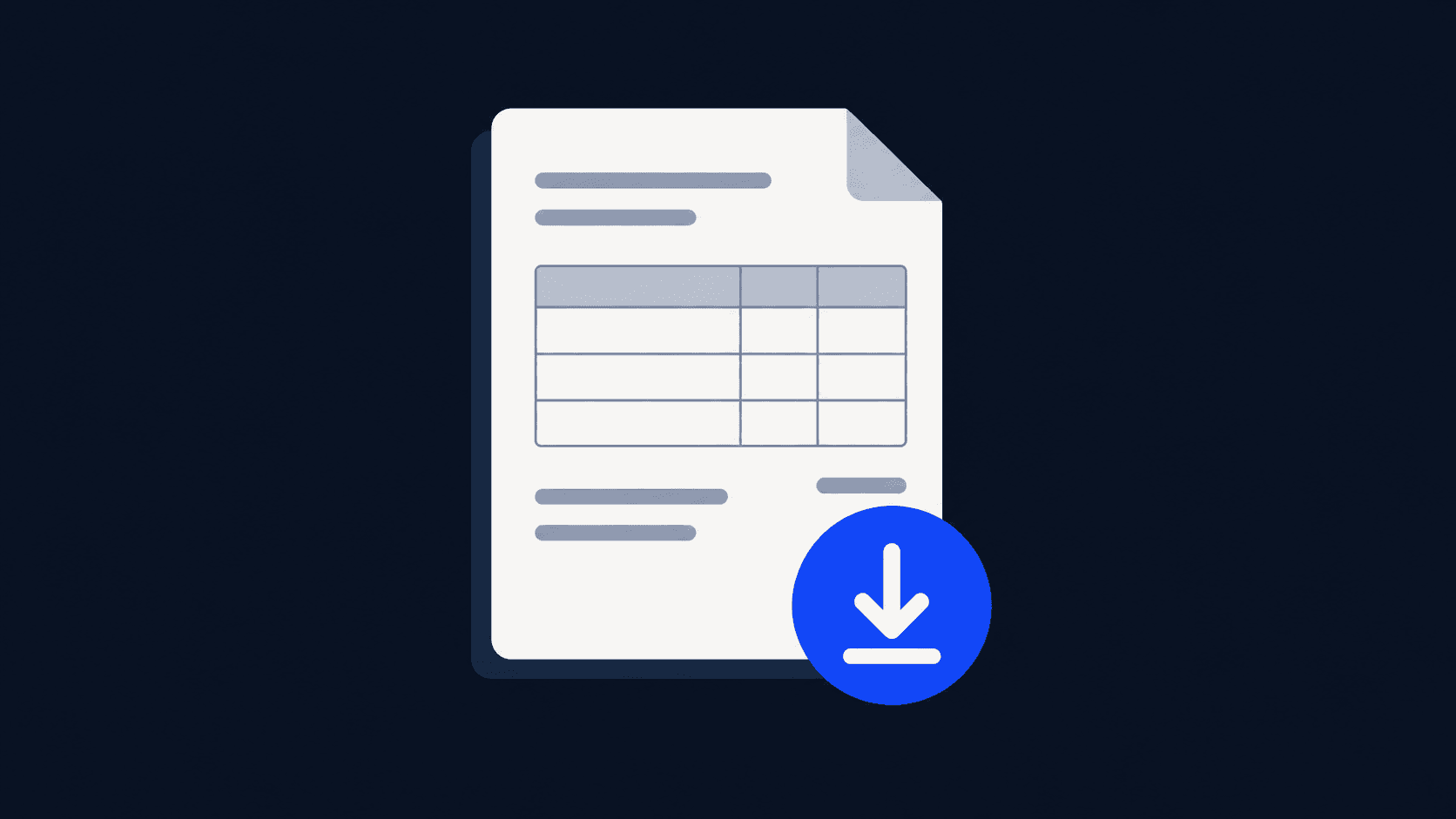
A Free Invoice Template, Filled In
This is a service invoice for a two-week consulting engagement, with a deposit already taken. Copy it into a document, swap the values, and keep the field order.
INVOICE

Rowan Vale Consulting Ltd                 Invoice no.    2026-0147
41 Thornbury Road                         Invoice date   15 October 2026
Bristol BS3 1SJ                           Supply date    1 to 12 October 2026
United Kingdom                            Due date       14 November 2026
VAT no. GB123456789                       Your ref.      PO-5582
hello@rowanvale.example

Bill to
Hartley Fabrication Ltd
Unit 12, Dunham Industrial Estate
Manchester M41 7JQ
VAT no. GB987654321

Description                                 Qty      Rate        Amount
Discovery workshop, 2 sessions              2      450.00        900.00
Process audit and written findings          6      450.00      2,700.00
Supplier shortlist and scoring model        1      600.00        600.00
                                                            ----------
                                            Subtotal          4,200.00
                                            Deposit received   -840.00
                                            Net due           3,360.00
                                            VAT at 20%          672.00
                                            ----------------------------
                                            TOTAL DUE         4,032.00 GBP

Partial invoice 2026-0131 of 28 September 2026 for 840.00 is deducted above.

Payment
Bank transfer to Rowan Vale Consulting Ltd
Sort code 04-00-75 · Account 12345678 · IBAN GB29 NWBK 6016 1331 9268 19
Reference: 2026-0147

Payment due by 14 November 2026. Statutory interest and recovery costs
apply to late payment under the Late Payment of Commercial Debts
(Interest) Act 1998.
Three decisions in there are worth copying along with the format. The deposit is deducted as its own line with the earlier invoice number beside it, so the tax point on that money stays traceable. The due date is a calendar date, not a window. And the payment reference is the invoice number, which is what matches a bank line to a document three weeks later.
How to Fill In Each Field Without Guessing
Five fields do the work. The rest of the template is typing.
Number it so you can still find it in three years
Unique is the only hard requirement in UK guidance, which gives you more freedom than most people take. Pick a pattern and keep it: 2026-0147 for a single series, or RV-2026-0147 if you invoice through more than one entity.
Two habits break the sequence. Restarting at 1 when you change tools leaves two invoice 0001s in the same tax year. Deleting a cancelled invoice leaves a hole where an auditor expects a document: if you void one, the number stays spent and you issue a credit note against it. A blank template enforces none of this, so the counter needs to live somewhere more durable than the file you last saved.
Write two dates, not one
The invoice date is when you issued the document. The supply date is when the work happened, and for a project it's a range. They land in different tax periods often enough that merging them into one "date" field is the quietest way to misreport a quarter.
Describe the work so a stranger could price it
The description is read by someone who wasn't in your kickoff call. "Consulting services" tells them nothing and invites a question that costs you a week. "Process audit and written findings, 6 days" tells them what they bought, at what volume, and whether it matches the purchase order in front of them.
Match the wording to your signed scope or contract where one exists. Where the line item and the statement of work use different language, accounts payable reads a discrepancy rather than a synonym.
Put the tax line in explicitly, even at zero
Write the rate and the amount as separate values, per rate, so nobody reverse-engineers either from the total. If you're below a registration threshold or the supply is exempt, say so in words rather than leaving the row off. A missing tax line reads as an oversight; a line saying the supply is outside the scope of VAT reads as a decision.
Reverse charge is the common cross-border case: when a business customer in another EU member state accounts for the tax instead of you, the invoice carries both VAT numbers, a zero tax amount and a note naming the reverse charge.
Give one payment route and one calendar date
One payment method, spelled out completely. Several routes with partial details each is how money reaches the wrong account.
Then name the date. Write "net 30" and the clock starts at a moment neither of you has written down. In the EU, Directive 2011/7/EU caps business-to-business terms at 60 days unless a longer period is expressly agreed and not grossly unfair, entitles you to statutory interest at the reference rate plus at least eight percentage points, and adds a minimum of 40 euros for recovery costs. Those remedies attach to a deadline, and a named date is the deadline.
Check the Totals Before You Send
Arithmetic errors cost more than formatting ones: they restart the approval cycle rather than slow it. Six checks, in the order they catch things:
- Re-extend every line. Quantity times rate, line by line. A rate typed into a template that still holds last client's quantity is the most common single error in a reused file.
- Apply tax after discounts and deposits, not before. Discount first, then tax the reduced figure. Taxing the gross and then discounting produces a total that's wrong in your client's favour, which nobody reports to you.
- Deduct each deposit once. If the deposit already carried tax on its own invoice, it comes off the net figure and the earlier invoice number sits beside it. In the example above that's one line, not a footnote.
- Round at the total, not per line. Rounding each line and then summing drifts by a few cents on a long invoice, which is enough to fail an automated three-way match.
- State the currency next to the total. "4,032.00" is ambiguous on an invoice crossing a border. "4,032.00 GBP" is not.
- Read both names and addresses out loud. A legal entity name that's close but not exact is grounds to return the document, and it's the error you're least likely to spot silently.
Lock the formula cells before you reuse a spreadsheet template. An overwritten =SUM() stays invisible until a client's accounts team finds it, and in a spreadsheet used as a working document it gets overwritten eventually.
Which Template Format Should You Use?
The format question is about how often you invoice, and whether anything downstream has to read the file.
| Format | Fits | Weak point |
|---|---|---|
Word or Google Docs | Occasional invoices, one or two clients | No arithmetic, so every total is typed by hand |
FormatWord or Google Docs FitsOccasional invoices, one or two clients Weak pointNo arithmetic, so every total is typed by hand | ||
Excel or Google Sheets | Multi-line project work | Formulas get overwritten on reuse |
FormatExcel or Google Sheets FitsMulti-line project work Weak pointFormulas get overwritten on reuse | ||
Fillable PDF | Sending a fixed layout you don't want edited | Numbering and records live outside the file |
FormatFillable PDF FitsSending a fixed layout you don't want edited Weak pointNumbering and records live outside the file | ||
Invoicing app | Recurring or multi-client billing | Monthly cost, and another login |
FormatInvoicing app FitsRecurring or multi-client billing Weak pointMonthly cost, and another login | ||
How often do you invoice?
Under about one invoice a month, a document template wins on effort. Past five a month the manual work stops being the typing and becomes the record-keeping: which numbers are used, which invoices are open, what you already chased.
Does anything have to read the file?
If your client's accounts system ingests invoices automatically, or if you bill public-sector buyers in the EU, a human-readable PDF may not be accepted as an invoice at all. Structured formats such as the EN 16931 standard behind XRechnung and ZUGFeRD exist for exactly this, and no word-processor template produces one. The format decision is covered in more depth in our guide to generating an invoice.
Who keeps the sequence?
This is the question that ends the template era. A file holds a number. It can't tell you the number is next, or that invoice 0138 has been open for 51 days.
Five Mistakes That Delay Payment
- Leaving the purchase-order field off. Many accounts-payable systems route on the PO number first and the vendor name second. No PO, no route, and nobody tells you.
- Sending it to the person who hired you. Your contact approves the work; somebody else pays it. Ask for the billing address on the first invoice, not the third.
- Describing a deposit as an invoice. If you labelled the up-front 20% an invoice, that document already created a tax point and has to be referenced and deducted on the final one. Label it a partial invoice and reference it explicitly.
- Attaching a scan. A photographed invoice fails text extraction and drops into a manual queue that moves at the speed of somebody's inbox.
- Setting terms you've never enforced. Terms you don't follow up on train a client to pay late. Deciding in advance what day you chase, and from what address, is worth more than the wording.
Freelancers also go looking for an invoice tool and bounce off the subscription, the recurring complaint in a freelance invoice template discussion on r/GrowCreativeAgency. Said plainly: at a handful of invoices a year, a copied template is the right answer and a tool is overhead.
When a Template Stops Being the Right Tool
A template is a blank. It holds no counter, no open-invoice list and no memory of what you already chased, and those gaps make the tenth invoice of the month harder than the first.
That is the gap meetergo closes from the booking side. It is built in Cologne, it spans scheduling, CRM, forms, e-signatures and invoicing for professional services through to healthcare, and it carries 90+ integrations including HubSpot, Pipedrive, Zapier and Make alongside a published REST API. The invoicing app sits at the end of a booking flow rather than beside it: a confirmed meeting becomes a quote, an approved quote becomes an invoice, and client details and line items carry over from the CRM record instead of being retyped. Invoices issue as structured EN 16931 files where a plain PDF is no longer accepted, recurring retainers go out on a schedule, overdue invoices trigger their own reminder sequences, and collection runs through the Stripe integration so the bill and the payment link are one artifact. Consultancies on the professional-services side report roughly 35% more billable hours.
Being straight about the limits: it isn't accounting software, so there's no VAT return filing and no bank reconciliation, and a tax advisor still needs a bookkeeping tool beside it. Invoicing also sits behind the Suite tier, so a freelancer who only wants invoices pays for apps they won't open. The Free plan is 0 euros forever with usage limits across every app, Light is 9.90 euros a month, Suite is 29.90 euros a month, and paid tiers run a 7-day trial with no card.

On OMR Reviews meetergo averages 4.8 out of 5 across 133 reviews (checked 15 October 2026), where consulting reviewers tend to name German hosting as the deciding factor rather than any single feature.
If the invoice is the last step of work a client booked with you, start free in 30 seconds and send the first one from the same place the meeting was booked. No credit card required.
Booking + video conferencing in one tool.

Booking + video conferencing in one tool.
FAQs
Is a free invoice template legally valid?
Yes, if it carries the required fields. Nothing about an invoice's legal standing depends on what produced it. A typed document with the right particulars is an invoice; a beautifully designed one missing a VAT number is a payment request.
Do I need a VAT number on my invoice?
Only if you're VAT registered, in which case yours is required, and your customer's too when they're liable for the tax. If you're not registered, leave the field out and state in words why no tax is charged.
What's the difference between an invoice and a receipt?
An invoice requests payment and creates the obligation; a receipt confirms payment already happened. UK guidance treats them as separate documents, and sending a receipt when a client asked for an invoice stalls an approval queue.
Should I charge a deposit instead of invoicing afterwards?
For new clients and project work, usually yes. A deposit at booking shifts the risk before you start rather than after you've delivered, and the wording you use to ask for payment upfront does most of the work in whether it lands.
How do I number invoices if I use a template?
Keep the counter outside the template, in a spreadsheet or a note, and write the next number down before you reuse the file. The sequence has to stay gapless per series, which means a voided invoice gets a credit note rather than a deletion.
Can I send an invoice as a PDF?
For consumers and most private-sector clients, yes. For public-sector buyers in parts of the EU, and for any client whose accounts system ingests structured files, a PDF may not count as an invoice. Ask which format the recipient accepts before the first invoice, not after it's rejected.
What should I do when an invoice goes unpaid?
Send a dated reminder referencing the invoice number, then state the interest and recovery costs you're entitled to. In the EU those remedies apply once the deadline passes, which is why a calendar date on the invoice matters more than the wording of the chase. Tools that automate the chase are compared in our invoice builder roundup.