
Key Takeaways
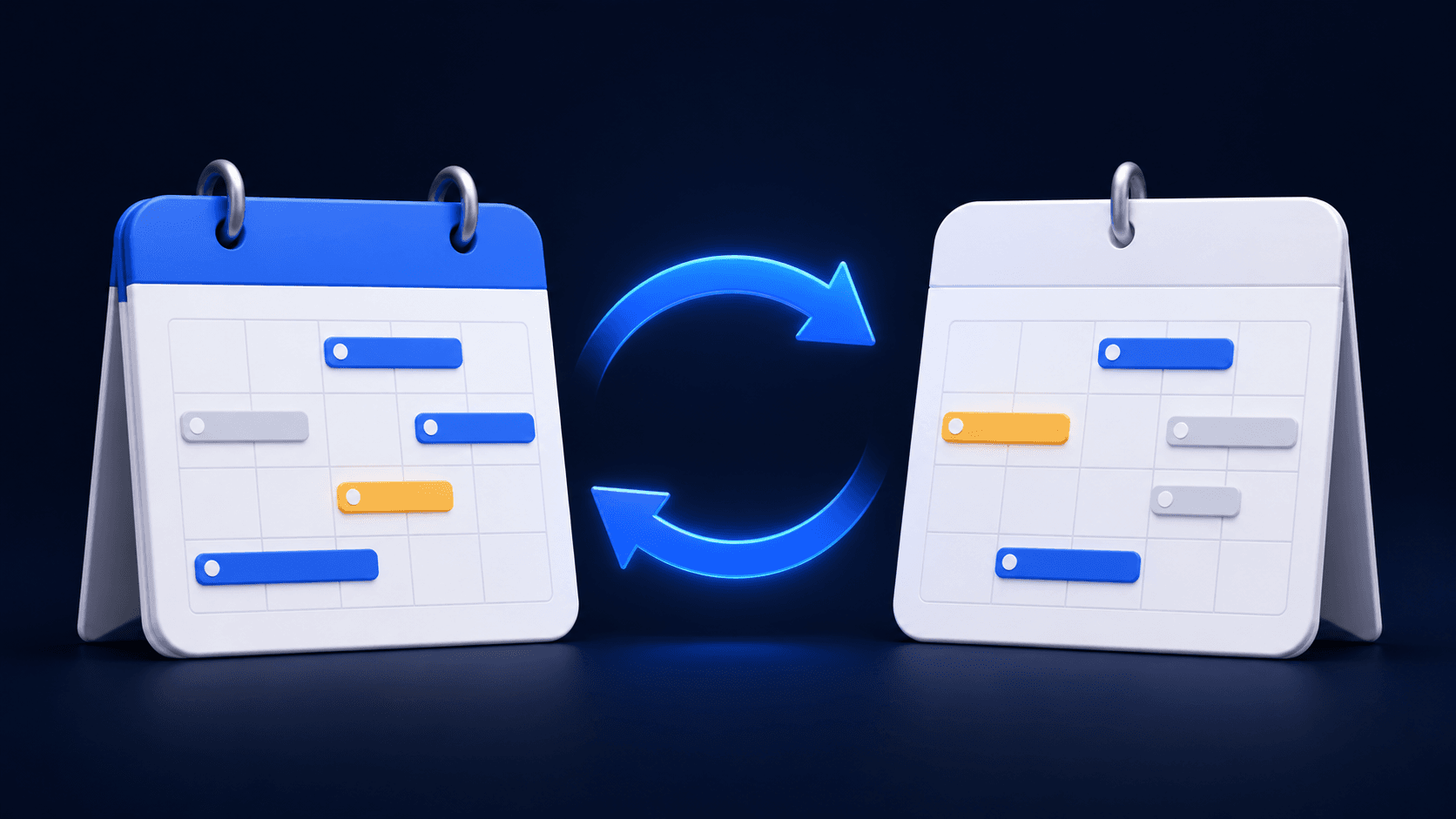
- Google to Apple is a real two-way sync. Add your Google account under Settings > Apps > Calendar on iPhone, or in Calendar settings on Mac, and events flow in both directions: edit on either side and the other updates.
- Apple to Google is a workaround, not a sync. Google offers no way to add an iCloud account, so the route is a public read-only feed: publish the iCloud calendar, paste its link into Google Calendar, and accept that Google refreshes it on its own schedule.
- Missing calendars are usually a settings problem, not a broken sync. By default only your own Google calendars and Birthdays reach Apple Calendar. Calendars shared with you have to be ticked on Google's sync selection page before they appear on your iPhone.
- If you only need one picture of your availability, skip the plumbing. A tool like meetergo reads Google, Apple, and Outlook calendars together and books against all of them, without publishing anything publicly.
The two halves of this task are nothing alike, and most guides gloss over that. Google Calendar into Apple Calendar is a supported, account-level sync that Apple and Google both document: five minutes of setup, edits travel in both directions. Apple Calendar into Google Calendar has no equivalent. Google can't log into iCloud, so the only built-in route is a published read-only feed with a lag you don't control. This guide walks through both directions honestly, including the settings page that fixes the "my calendar didn't sync" complaint in most cases.

Sync Google Calendar to Apple Calendar on iPhone
This direction is the easy one. You're not linking two calendars; you're adding your Google account to iOS, the same way you'd add it for Mail. Apple's account setup guide documents the current path:
- Open Settings, tap Apps, then tap Calendar. On older iOS versions, Calendar sits directly in the main Settings list instead.
- Tap Calendar Accounts, then Add Account.
- Choose Google and sign in with your email address and password.
- iOS offers to sync Mail, Contacts, and Calendars from that account. Turn off whatever you don't want; only the Calendars toggle matters here.
- Open the Calendar app. Your Google events appear alongside your iCloud ones, grouped under a Gmail heading in the Calendars list.
From now on the sync is two-way: create or move an event on your iPhone and it lands in Google Calendar, and vice versa. Google's setup instructions confirm one wrinkle for older devices: if your iPhone isn't on a recent iOS version and your Google account uses 2-Step Verification, you'll need an app password instead of your normal one.
Already added the account for Mail?
If your Gmail address is on the phone but no events show up, the account probably has calendar sync switched off. Go back to Settings > Apps > Calendar > Calendar Accounts, tap the Google account, and turn on Calendars. No need to re-add anything.
Shared calendars missing? Fix it on Google's sync page
Here's the part that generates most of the confusion online. By default, Apple Calendar receives the calendars listed under My Calendars in Google Calendar, plus Birthdays. Anything shared with you, a partner's calendar, a team calendar, a project calendar you subscribed to, does not sync until you say so.
The fix lives on Google's sync selection page. Open it in a browser, sign in with the same Google account, tick the calendars you want on your devices, and save. Give the Calendar app a moment, then pull down to refresh. Sudden sync complaints are common enough that a July 2026 post on r/GoogleCalendar describes calendars that had been syncing both ways simply stopping one week across an Apple and Android setup; before assuming a bug like that, check this page first, because an unticked calendar produces exactly the same symptom.
With the Google account connected, the next step is making the app itself behave: separate calendars per role, a sensible default calendar so new events do not land in the wrong account, and alerts that fire early enough. Our guide to using the Calendar app on iPhone covers those settings in order.
Add Google Calendar to Apple Calendar on Mac
The Mac flow mirrors the iPhone one, with one extra control worth knowing about:
- Open the Calendar app.
- In the menu bar, click Calendar > Settings (older macOS versions call it Preferences), then the Accounts tab.
- Click Add, select Google, click Continue, and follow the sign-in steps.
- Back on the Accounts tab, set Refresh Calendars to control how often the Mac checks Google for changes.
That refresh interval is the honest answer to "why did my event take a few minutes to show up on the Mac": desktop Calendar polls on the schedule you set rather than updating instantly. Pick the shortest interval if you live in both calendars all day.
What doesn't survive the trip
Two-way doesn't mean identical. Google keeps a short list of features that don't work once its events are viewed through Apple Calendar: email notifications for events don't fire, you can't create a brand-new Google calendar from inside Apple's app, and the enterprise Room Scheduler stays behind. Apple adds a cosmetic one in its multiple calendars guide: for Google accounts, the calendar color is set by the server, so recoloring on iPhone doesn't always stick.
None of these breaks day-to-day use. Events, edits, invitations, and alerts all travel fine. But if your workflow depends on Google-side email notifications, keep the Google Calendar app around for that piece.
Sync Apple Calendar to Google Calendar
Now for the direction the other guides undersell. There's no Add Account button for iCloud inside Google Calendar, and no toggle that makes your Apple events appear in Google. A September 2025 r/GoogleCalendar thread captures the frustration: the poster had Google events flowing into Apple Calendar without trouble, yet couldn't get their iCloud calendar into Google's desktop view even after pasting its URL into Google Calendar's settings. The built-in route is a published read-only feed, and it's picky about how you hand it the link.
Here's the flow:
- On your iPhone, open Calendar, tap Calendars, then tap the info button next to the iCloud calendar you want Google to see.
- Turn on Public Calendar and tap Share Link to copy the URL. The same switch exists at iCloud.com, per Apple's iCloud calendar sharing guide. Note that this only works for calendars stored in iCloud, and only the calendar's owner can publish one.
- On a computer, open Google Calendar. Next to Other calendars, click +, then From URL, paste the link, and click Add calendar. Those steps come from Google's subscribe-by-link instructions. If Google rejects the pasted address, swap the
webcal://prefix iCloud uses forhttps://and add it again.
Know what you're signing up for before you rely on it:
- It's read-only. You can't edit or delete iCloud events from Google Calendar; changes happen on the Apple side and flow down.
- It refreshes when Google decides. Subscribed feeds update on Google's schedule, not in real time, so a lunch you just moved can sit in the old slot for a while.
- The link is public. Anyone who has the URL can subscribe. Don't publish a calendar with sensitive appointments; create a separate iCloud calendar containing only what Google needs to see. Our guide to sharing a calendar on iPhone covers creating purpose-built calendars like this.
If the goal is the reverse of what this section does, giving an Apple-centric household access to a Google calendar, share it from Google's side instead; we've documented that in how to share a Google calendar.
When two synced calendars still aren't enough
The public-feed workaround shows its limits fast: households that edit each other's events, freelancers whose clients book against a work calendar, anyone who needs Google to hold a live copy rather than a delayed snapshot. At that point you have two real options.
For true two-way replication between accounts, a dedicated sync service does what the built-in tools won't; we looked at one in detail in our CalendarBridge review. Mind that these services are subscriptions, and you're handing calendar access to a third party.
If what you actually want is for other people to see when you're free and book you, syncing calendar copies around is the long way. meetergo's Google Calendar integration and Apple Calendar integration connect both accounts with two-way sync, merge them into a single availability picture, and hand out a booking page that already knows about every commitment on either calendar. Nothing gets published publicly, confirmations land on the calendar you choose, and the free plan covers a personal booking page at no cost, with servers in Europe and full GDPR compliance behind it. It won't merge your calendars into one editable view, though; it solves the availability problem, not the two-inboxes problem.
Start for free and connect both calendars in a couple of minutes. No credit card required.
Common mistakes when syncing Google and Apple calendars
- Expecting the iCloud feed in Google to be editable. The From URL route is view-only by design. If you catch yourself editing iCloud events in Google Calendar, you need a sync service or a different primary calendar, not a settings tweak. Our online calendar comparison helps with the primary-calendar decision.
- Declaring the sync broken when only shared calendars are missing. Your own events arrive, the team calendar doesn't, and it looks like a bug. It's the sync selection page; tick the shared calendars and they appear.
- Leaving the old Delegation setup on in Mac Calendar. Google's instructions are explicit: if you ever synced via the Delegation tab in Calendar's account settings, uncheck all of those calendars, or the modern account sync misbehaves.
- Creating a calendar on the wrong side. New calendars have to be created where they live, in Google Calendar for Google, since Apple's app can't create a Google calendar. A user in a July 2026 r/applehelp thread hit the same wall with sharing: a Google calendar viewed in Apple Calendar can only be shared from Google itself.
- Publishing your main calendar instead of a filtered one. The public link exposes every event on that calendar. Keep a slim, dedicated iCloud calendar for the feed and leave your dentist appointments off it.
Booking + video conferencing in one tool.

Booking + video conferencing in one tool.
FAQ
Is the sync between Google Calendar and Apple Calendar instant?
On iPhone, account-level sync is close to immediate in normal use. On Mac, the Calendar app checks Google at the Refresh Calendars interval you set in account settings. Public iCloud feeds inside Google Calendar are the slow lane: Google refreshes them on its own schedule, so treat them as a delayed mirror.
Can I edit Google Calendar events from Apple Calendar?
Yes. Once the account is added, creating, moving, and deleting events works from either app and syncs both ways. The exceptions sit at the calendar level: new Google calendars, Google's email notifications, and Room Scheduler only work in Google's own apps.
Why does a calendar show on calendar.google.com but not on my iPhone?
Because device sync has its own allowlist. Only My Calendars and Birthdays sync automatically; everything else waits until you select it at google.com/calendar/syncselect while signed in to the same account. Two minutes there beats an hour of reinstalling apps.
Can Google Calendar show my iCloud events without a public link?
Not with built-in tools. Private iCloud sharing only reaches other Apple accounts, and Google can't sign in to iCloud. Your options are the public read-only feed described above or a third-party two-way sync service.
Do these steps work on an iPad?
Yes. Google's documentation covers iPhone and iPad with the same flow, and the Settings path is the same: Apps, then Calendar, then Calendar Accounts. The Mac steps apply to any recent macOS version.
What if my second calendar is Outlook, not Google?
The same asymmetry shows up with different plumbing. We've written up the Microsoft side separately in how to sync Google Calendar with Outlook, and if you're juggling two Google accounts rather than two platforms, see our guide to syncing two Google calendars.