
In partnership with HubSpot. This article contains affiliate links — we may earn a commission at no extra cost to you.
AEO (Answer Engine Optimization) is the practice of structuring content so that AI platforms — ChatGPT, Perplexity, Google AI Overviews — cite your brand when answering buyer questions.
Traditional SEO targets ranked positions in Google's blue-link results. AEO targets your presence inside the generated answer itself. The two disciplines overlap but require different content structures, different measurement systems, and, increasingly, different agency service offerings.
For digital agencies, the shift matters for a direct commercial reason. Clients ask AI tools which agencies to hire. If your agency's name does not appear in those answers, you are invisible at the exact moment a buyer forms a shortlist.
This guide covers what AEO is, how it differs from SEO, what agencies need to change in their service lines, and which tools help execute AEO at scale in 2026.

What is AEO and how does it differ from traditional SEO?
Traditional SEO optimizes content to rank on page one of Google's blue-link results for a given query. Success is measured by position, impressions, and organic clicks. The game is ranking above competitors.
AEO optimizes content to be cited inside AI-generated answers. Success is measured by citation rate, brand mention frequency across LLM responses, and share of voice in AI tools for your priority query set. The game is being included in the answer — not ranked below it.
The underlying mechanics are different too. Traditional SEO is driven by backlinks, page authority, keyword density, and crawl signals. AEO is driven by entity clarity, semantic triples, structured data, and brand mentions distributed across authoritative third-party sites.
AI models do not rank URLs — they build knowledge graphs and pull from sources they deem trustworthy.
The two disciplines are not opposites. High-quality, authoritative content that performs well in SEO tends to get cited in AI answers too.
But the specific optimizations that push content from "good SEO" to "frequently cited by AI" require an additional layer of work that most agency SEO playbooks do not yet include.
Why generative search broke the old agency playbook
Three structural shifts happened in rapid succession between 2024 and 2026, and each one eroded a core agency revenue assumption.
First, Google deployed AI Overviews across more than 40 percent of US queries. Synthesized answers now sit above traditional results on informational and commercial-investigation queries.
Organic click-through rates on those query types dropped across the industry, which means the traffic agencies promised clients from content investment declined — not because the content got worse, but because the results page changed.
Second, AI-native search grew from novelty to purchase-stage habit. ChatGPT referral traffic grew over 200 percent between mid-2025 and Q1 2026. Perplexity grew 180 percent over the same period.
Buyers now use these tools to shortlist vendors, compare platforms, and draft RFPs. An agency that does not appear in those AI answers is not considered.
Third, the standard agency deliverable — monthly rank reports and organic traffic dashboards — became increasingly misleading. Organic traffic from traditional search may be declining while AI-referred traffic is growing.
Rank tracking tools cannot see inside ChatGPT responses. Agencies reporting "rankings" to clients are measuring a lagging indicator that misses the channel where buyers now do their research.
The agencies gaining ground in 2026 have updated both their internal workflows and their client-facing deliverables to account for where search actually happens. That means adding AEO as a distinct service layer — not replacing SEO, but running them in parallel.

How AEO ranking factors differ from SEO
AI citation is not random. LLMs draw from sources they perceive as authoritative, unambiguous, and well-structured. Understanding those signals tells agencies where to invest effort.
- Entity clarity: AI models build knowledge graphs around named entities — people, companies, products, concepts. Your brand must be consistently described across your own site, Wikipedia, review platforms, social profiles, and third-party publications. Inconsistent or sparse entity data leads to low confidence and fewer citations.
- Semantic triples: LLMs understand relationships — subject, predicate, object. Content that clearly states "[Brand] helps [audience] achieve [outcome]" creates parsable semantic relationships. Vague brand positioning dilutes this signal.
- Structured data and FAQ markup: Schema.org markup gives AI crawlers machine-readable context. FAQ schema, HowTo schema, and Article schema all improve the probability that a page's content gets pulled into AI-generated responses rather than paraphrased poorly.
- Citation breadth across third-party domains: AI tools heavily weight sources they have seen cited elsewhere. Brand mentions in industry publications, analyst reports, podcast transcripts, and review aggregators (G2, Capterra, Trustpilot) all contribute to citation confidence. This is the AEO equivalent of link building — except mentions matter, not just links.
- Direct question-answer structure: Content that answers a specific question in the first 40-60 words, then provides evidence, outperforms long-form content that buries the answer. AI tools are answer engines — they reward content that behaves like one.
Tools like Surfer SEO, Clearscope, and MarketMuse remain genuinely useful for topical authority and keyword clustering. Frase and Jasper accelerate content production.
None of them were built with AEO citation mechanics in mind, so agencies need to layer AEO-specific optimizations on top of whatever SEO tooling they already run.
What digital agencies need to change in their service offerings
AEO is not a rebrand of SEO. It requires expanding the scope of what agencies audit, create, and report on. The specific service-line changes that matter most in 2026:
- Add an AI visibility audit to onboarding. Before starting content work, run the client's brand through ChatGPT, Perplexity, and Gemini for their 20-30 highest-priority queries. Document which competitors appear and which contexts your client is missing. This baseline shapes the entire content strategy.
- Rewrite content briefs around answer structure. Every brief should specify the primary question the page answers, the answer in under 60 words, and the supporting evidence layer. This is a material change from keyword-density briefs.
- Build an entity footprint as a client deliverable. Consistent brand descriptions across G2, Clutch, industry directories, and press coverage build the entity confidence AI models need. This work is PR-adjacent and often falls outside the traditional SEO scope of work.
- Report on AI share of voice, not just rankings. Monthly client reports should include brand mention rate in AI answers for priority queries, alongside traditional organic metrics. Clients who only see rank reports are getting a partial picture of how their brand performs in search.
- Price AEO as a distinct retainer component. The research, content restructuring, entity-building, and measurement work required for AEO takes real time. Bundling it into an existing SEO retainer without adjusting scope is a path to underdelivering on both.
The agency AEO tech stack for 2026 — and where HubSpot fits
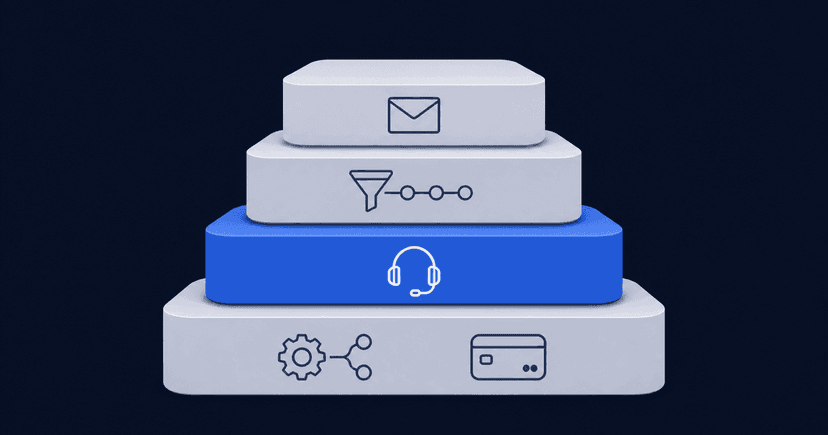
Executing AEO at agency scale requires tools across four functions: AI visibility monitoring, content production, brand-footprint distribution, and lead capture. Here is how a practical 2026 stack maps to those functions.
- AI visibility monitoring: Dedicated tools for this layer include Brandwatch (brand mentions across LLM outputs), Profound, and Peec.ai. These track citation rates and share of voice in AI answers. Most SEO platforms do not yet cover this layer adequately. For agencies already in the HubSpot ecosystem, HubSpot AEO ($50/month) tracks brand visibility across ChatGPT, Gemini, and Perplexity with CRM-connected prompt suggestions — making it the most natural starting point before evaluating standalone monitoring tools.
- Content production and optimization: Surfer SEO and Clearscope handle keyword and topical clustering. For answer-structured content at scale, Breeze AI within HubSpot's Content Hub adds a layer those tools lack: an AI Blog Research Agent that surfaces query gaps, a writer that follows AEO structure norms, and Content Remix to multiply citation surface area from a single high-performing page.
- Brand-footprint distribution: PR tools (Prowly, Muck Rack) for media placements, plus systematic review generation on G2, Capterra, and Clutch. Each third-party mention of the client's brand builds the entity confidence that AI models need.
- Lead capture and CRM: AEO-driven traffic arrives ready to talk. A frictionless booking experience at that moment of intent is what converts the citation into a pipeline opportunity. This is where the CRM and scheduling layer matters.
The reason agencies gravitate toward HubSpot's Content Hub as an all-in-one option is consolidation, not dominance. For agencies managing multiple client accounts, having content production, lead capture, CRM, and reporting in one platform reduces handoff friction and makes client attribution reports simpler to build.
It is not the best standalone tool in each category — but it is the only platform that covers all four functions without major integration work.

HubSpot's Breeze AI specifically addresses the content production layer. The Breeze Prospecting Agent helps agencies identify which companies are actively searching for services the client offers — useful for ABM campaigns that complement AEO content work.
The Social Agent repurposes long-form AEO content into LinkedIn and X posts, each of which creates an additional brand mention surface across the web.
How to measure AEO success in 2026
AEO measurement requires a different metric set than traditional SEO. The five layers that matter most:
- AI citation rate: How often the brand appears as a cited source in AI-generated answers for target queries. Track per platform — Perplexity cites 13x more often than ChatGPT, so platform mix matters.
- LLM share of voice: Brand mention rate versus named competitors across 50-200 priority queries, tracked weekly. This is the AI equivalent of search market share.
- AI sentiment score: Whether AI platforms characterize the brand positively, neutrally, or negatively. A negative mention is worse than no mention. Low sentiment often traces to thin or contradictory brand descriptions across third-party sites.
- Branded search growth: The uplift in direct and branded Google queries after AI exposure. Most AI-influenced buyers end up typing the brand name into Google or directly into a URL bar. Branded query growth in Search Console is the primary downstream indicator of AI visibility working.
- Traditional rankings as lagging indicator: Google rankings still matter — especially for navigational and high-commercial-intent queries. But treat them as confirmation, not the primary signal. AEO success typically shows in branded search and AI referral traffic before it shows in traditional rank data.
A practical reporting cadence: check AI referral sessions and citation rate weekly (10 minutes), do a full dashboard review monthly, and run a quarterly AEO audit that re-runs priority queries manually across AI platforms to spot competitor movement. The agencies that build this cadence now will have baseline data when clients start asking about it.
From AEO-driven traffic to booked discovery call: the full workflow
AEO traffic converts differently than standard organic traffic. A buyer who finds your agency by asking ChatGPT "best digital agencies for B2B SaaS" and sees your name in the answer arrives with prior context.
They are not browsing — they are evaluating. The window between landing on your site and being willing to book a call is shorter.
The workflow that captures this intent looks like this:
- AI answer cites your content → buyer clicks the link or searches your name directly.
- Buyer lands on your AEO content page → they read the answer that got cited, then explore the site.
- Prominent booking CTA on the page → a frictionless scheduling widget captures the meeting before the buyer moves on to the next tab.
- Meeting data syncs to CRM → contact record created, source and UTM data attached, deal opened.
Frequently asked questions
Should digital agencies replace SEO with AEO in 2026?
No. SEO and AEO address different surfaces and require different optimizations, but they share the same foundation: authoritative, well-structured content on a technically sound site. The right approach is to run them in parallel. Add AEO-specific optimizations — answer-first structure, entity clarity, FAQ schema — on top of existing SEO work rather than replacing it. Agencies that dropped SEO for AEO alone would lose the traditional search traffic that still drives the majority of revenue for most clients.
How do AI models decide which sources to cite?
AI models weight sources based on perceived authority, consistency of information across multiple references, and the structure of the content itself. Perplexity and Google AI Overviews favor pages that directly answer the query in the first paragraph, cite credible external statistics, and use structured markup. ChatGPT draws more heavily from training data — meaning brands with wider, more consistent third-party coverage tend to appear more often. Both patterns reward entity clarity and citation breadth over raw publishing volume.
What is a realistic timeline to see AEO results?
Perplexity updates citations within days of new content being indexed. Most teams see measurable Perplexity share-of-voice improvement within 4-6 weeks of focused AEO content work. ChatGPT and Gemini reflect training data on longer cycles — typically weeks to months depending on model update schedules. Broader LLM visibility improvement across all platforms usually takes one to two quarters of consistent entity-building and content restructuring.
Can existing SEO tools like Surfer or Clearscope handle AEO?
Surfer SEO and Clearscope are strong for topical authority mapping and competitive content benchmarking — they were built for traditional SEO, not AI citation tracking. Use them for keyword and topical clustering, then layer AEO-specific techniques on top: answer-first intros, FAQ schema, and entity-consistency audits. Dedicated AEO monitoring tools like Profound, Peec.ai, and Brandwatch handle citation tracking that SEO platforms cannot.
How should agencies price AEO services for clients?
The most common model in 2026 is a separate AEO retainer priced at 30-50 percent of the existing SEO retainer, covering AI visibility audits, answer-structured content, entity-footprint management, and monthly AI share-of-voice reporting. Bundling it into existing SEO scope without a price adjustment leads to underdelivering — the work is additive, not a replacement.